Algebra, Abstract Algebra, and Linear Algebra
Reference documents in Algebra, Abstract Algebra, and Linear Algebra.
Documents in Algebra, Abstract Algebra, and Linear Algebra
Page 2 of 2-
These books use a teacherly writing style and a careful blend of skills development and conceptual questions to meet the unique needs of the developmental math student. It takes advantage of experiences in the classroom and an editing eye to offer one of the most well-rounded series available, written with the developmental learner in mind.
-
This book explores the use of symmetries through descriptions of the techniques of Lie groups and Lie algebras. It develops the models, theoretical framework, and mathematical tools to understand these symmetries.
-
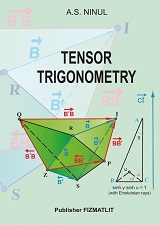
The tensor trigonometry is development of the flat scalar trigonometry from Leonard Euler classic forms into general multi-dimensional tensor forms with vector and scalar orthoprojections and with step by step increasing complexity and opportunities. Described in the book are fundamentals of this new mathematical subject with many initial examples of its applications.
-
This book provides a complete and contemporary perspective on classical polynomial algebra through the exploration of how it was developed and how it exists today. It facilitates a thorough understanding of algebra and illustrates how the concepts of modern algebra originally developed from classical algebraic precursors.
-
Written and reviewed by a team of highly experienced instructors, this book provides a comprehensive and multilayered exploration of algebraic principles. It is suitable for a typical introductory algebra course, and was developed to be used fexibly.
-
This open access textbook presents a comprehensive treatment of the arithmetic theory of Quaternion Algebras and orders, a subject with applications in diverse areas of mathematics.
-
Based on lectures given at University of California, Davis, this text constitutes a substantial, abstract introduction to linear algebra.
-
Linear algebra permeates mathematics, perhaps more so than any other single subject. It plays an essential role in pure and applied mathematics, statistics, computer science, and many aspects of physics and engineering.
-
This is a course in matrix algebra, with a focus on concepts that are often used in probability and statistics. Matrix algebra is one of the most important areas of mathematics for data analysis and for statistical theory.
-
The author makes clear in the foreword that this text is not a linear algebra text. It avoids much of the theory associated with linear algebra; although, the author does touch on theorems as necessary. Avoiding theory but using the term "theorem" might require some discussion in class that is avoided in the textbook.
-
This introduction to modern or abstract algebra addresses the conventional topics of groups, rings, and fields with symmetry as a unifying theme, while it introduces readers to the active practice of mathematics. Its accessible presentation is designed to teach users to think things through for themselves and change their view of mathematics from a system of rules and procedures, to an arena of inquiry.
-
Popular computer algebra systems such as Maple, Macsyma, Mathematica, and REDUCE are now basic tools on most computers. Efficient algorithms for various algebraic operations underlie all these systems. Computer algebra, or algorithmic algebra, studies these algorithms and their properties and represents a rich intersection of theoretical computer science with classical mathematics.
-
This book is designed to introduce students to the use of Linear Algebra to solve real-world problems. These materials were developed specifically for students and instructors working in a “flipped classroom” model that emphasizes hands-on problem-solving activities during class meetings, with students watching lectures and completing readings and assignments outside of the class.
-
Combinatorics on words has arisen independently within several branches of mathematics, for instance, number theory, group theory and probability, and appears frequently in problems related to theoretical computer science. The first unified treatment of the area was given in Lothaire's Combinatorics on Words. Since its publication, the area has developed and the authors now aim to present several more topics as well as giving deeper insights into subjects that were discussed in the previous volume. An introductory chapter provides the reader with all the necessary background material. There are numerous examples, full proofs whenever possible and a notes section discussing further developments in the area.