Compiler/Interpreter Design and Construction
Reference documents in Compiler/Interpreter Design and Construction.
Documents in Compiler/Interpreter Design and Construction
Page 1 of 1-
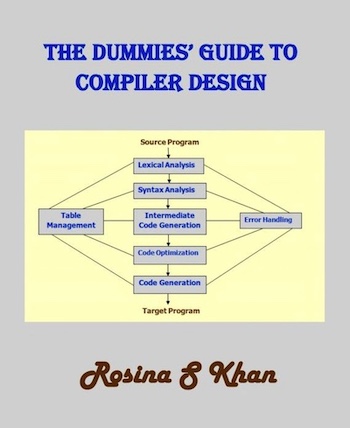
A refreshing antidote to heavy theoretical tomes, this book is a concise, practical guide to modern compiler design and construction by an acknowledged master.
-
The name compiler has been given to a computer program which will accept as data a program in a problem-oriented language, such as Algol or Fortran, and produce as output a computer-oriented code which, after possibly some further processing by an assembler or loader, will be capable of being obeyed by a computer and produce results equivalent to those defined by the program in the problem-oriented language. This definition is rather vague and has to be as the word compiler is used for rather a wide range of computer programs with very different characteristics.
-
This book provides a practically-oriented introduction to high-level programming language implementation. It demystifies what goes on within a compiler and stimulates the reader's interest in compiler design, an essential aspect of computer science. Programming language analysis and translation techniques are used in many software application areas.
-
This extremely practical, hands-on approach to building compilers using the C programming language includes numerous examples of working code from a real compiler and covers such advanced topics as code generation, optimization, and real-world parsing. It is an ideal reference and tutorial.
-
The book provides a thorough introduction to compiler design and covers topics such as context-free grammars, fine state machines, and syntax-directed translation. Focus on the broader set of problems faced in software design and software development.
-
This free book is an introductory level text for compiler design courses, that emphasizes problem solving skills. The concepts are clearly presented with sampler problems and diagrams to illustrate the concepts. The text also covers lex and yacc two compiler generating tools in UNIX.
-
This textbook is intended for an introductory course on Compiler Design, suitable for use in an undergraduate programme in computer science or related fields.
-
A hands-on approach to understanding and building compilers using the programming language Racket.
-
This book is a comprehensive guide to compiler construction, covering both theoretical concepts and practical implementation techniques. It delves into lexing, parsing, semantic analysis, optimization, and code generation.
-
A compiler translates a program written in a high level language into a program written in a lower level language. For students of computer science, building a compiler from scratch is a rite of passage: a challenging and fun project that offers insight into many different aspects of computer science, some deeply theoretical, and others highly practical.
-
We will build a small functional language called Fun which is a partial Haskell 2010 toy language; complete with a parser, type inference, datatypes, pattern matching, desugaring, typeclasses, higher-kinded types, monadic IO, arbitrary-rank polymorphism, records, Core language, STG intermediate language, lazy evaluation, interpreter, native code generator, a runtime, and several optimization passes.