Computer, Digital, and Mathematical Music
Reference documents in Computer, Digital, and Mathematical Music.
Documents in Computer, Digital, and Mathematical Music
Page 1 of 2-
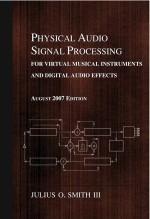
Spectral Audio Signal Processing is the fourth book in the music signal processing series by Julius O. Smith. One can say that human hearing occurs in terms of spectral models. As a result, spectral models are especially useful in audio applications. For example, with the right spectral model, one can discard most of the information contained in a sound waveform without changing how it sounds.
-
This book describes signal-processing models and methods that are used in constructing virtual musical instruments and audio effects. Specific topics considered include delay effects such as phasing, flanging, the Leslie effect, and artificial reverberation; virtual acoustic musical instruments such as guitars, pianos, bowed strings, woodwinds, and brasses; and various component technologies such as digital waveguide modeling, wave digital modeling, commuted synthesis, resonator factoring, feedback delay networks, digital interpolation, Doppler simulation, nonlinear elements, finite difference schemes, passive signal processing, and associated software.
-
This book introduces audio programming to Processing programmers through the Beads library. It covers topics such as synthesis, sampling and general sound-mangling in such a way that is appropriate for beginners, or more experienced programmers who want to expand their repetoire.
-
Sound manipulation is an activity that find an increasing number of practitioners in the fields of artistic expression, technology, and science. These people have different goals and different backgrounds, but they greatly benefit from talking to each other using a common language and common tools.
-
This book is a creative audio coding tutorial for the SuperCollider audio synthesis programming language. SuperCollider 3 was released as open source software in the early 2000s and has been one of the key programming languages for sound, music and instrument design for two decades.
-
Pure Data (Pd) is a real-time graphical programming environment for audio, video, and graphical processing. This publication is a compilation of texts describing different approaches to pd, a profile of its usage and development.
-
Algorithmic Composition is the technique of using algorithms to create music – composing by means of formalizable methods – has a century old tradition not only in occidental music history.
-
This book provides a wealth of information for the teacher, the student, or the interested amateur to understand, at varying levels of technicality, the interplay between two ancient disciplines. A must-have book if you want to know about the music of the spheres or digital music and much in between.
-
Online music services are taking off, yet few people know how to take full advantage of them. From Internet radio services to online jukeboxes and music download stores, there are scores of new options for music lovers to consider, all just a mouse-click away. THE MUSIC INTERNET UNTANGLED makes sense of these options and shows readers how to make savvy use of these services. Online music is about more than delivering music conveniently. It's about finding more good music than you ever thought possible. It's about getting A LOT more music for your money - legally. It's about finding new ways to bring music into your life.
-
This book offers a lively exploration of the mathematics, physics, and neuroscience that underlie music in a way that readers without scientific background can follow, explains why the perception of music encompasses the physics of sound, the functions of the ear and deep-brain auditory pathways, and the physiology of emotion.
-
This book provides a wealth of information for the teacher, the student, or the interested amateur to understand, at varying levels of technicality, the interplay between two ancient disciplines. A must-have book if you want to know about the music of the spheres or digital music and much in between.
-
Many people intuitively sense that there is a connection between mathematics and music. If nothing else, both involve counting. There is, of course, much more to the association. David Wright's book is an investigation of the interrelationships between mathematics and music, reviewing the needed background concepts in each subject as they are encountered. Along the way, readers will augment their understanding of both mathematics and music. The text explores the common foundations of the two subjects, which are developed side by side.
-
This text is a compilation of courses materials in Music Technology, Digital Synthesis, and Computer Assisted Composition. It blends electro-acoustic composition exercises with SuperCollider and Logic Pro topics. The goal is getting actual sounds as quickly as possible and enough SuperCollider and Logic Pro languages to prevent glassy eyes when reading the help files that come with SuperCollider and Logic Pro.
-
The book is designed for self-study, principally for composers. It begins with explanations of basic programming and acoustic principles then gradually builds up to the most advanced electronic music processing techniques, using Pure Data (Pd).
-
This is the first book to develop both the theory and the practice of synthesizing musical sounds using computers. Each chapter starts with a theoretical description of one technique or problem area and ends with a series of working examples (over 100 in all), covering a wide range of applications.