Graph Theory
Reference documents in Graph Theory.
Documents in Graph Theory
Page 1 of 2-
The results of cache-simulation experiments with an abstract machine for reducing combinator graphs are presented. The abstract machine, called TIGRE, exhibits reduction rates that, for similar kinds of combinator graphs on similar kinds of hardware, compare favorably with previously reported techniques.
-
This book consists of some of the main areas of research in graph and network theory applied to physics. It includes graphs in condensed matter theory, such as the tight-binding and the Hubbard model. It follows the study of graph theory and statistical physics by means of the analysis of the Potts model ...
-
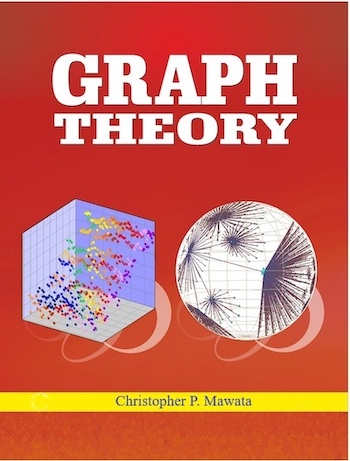
As an introductory book, this book contains the elementary materials in map theory, including embeddings of a graph, abstract maps, duality, orientable and non-orientable maps, isomorphisms of maps and the enumeration of rooted or unrooted maps, particularly, the joint tree representation of an embedding of a graph on two dimensional manifolds, which enables one to make the complication much simpler on map enumeration.
-
The vast majority of concepts in graph theory are whole-number based. Invariants from chromatic number to arboricity only take on integer values. In this book the authors explore generalizations of core graph theory notions by allowing real values to substitute where normally only integers would be permitted. The aim is to prove "fractional analogues" of the theorems of traditional graph theory.
-
Nowadays, graph theory is an important analysis tool in mathematics and computer science. Because of the inherent simplicity of graph theory, it can be used to model many different physical and abstract systems such as transportation and communication networks, models for business administration, political science, and psychology and so on.
-
Requiring only high school algebra as mathematical background, the book leads the reader from simple graphs through planar graphs, Euler's formula, Platonic graphs, coloring, the genus of a graph, Euler walks, Hamilton walks, and a discussion of The Seven Bridges of Konigsberg.
-
This comprehensive text covers the important elementary topics of graph theory and its applications. In addition, he presents a large variety of proofs designed to strengthen mathematical techniques and offers challenging opportunities to have fun with mathematics.
-
The primary aim of this book is to present a coherent introduction to graph theory, suitable as a textbook for advanced undergraduate and beginning graduate students in mathematics and computer science. It provides a systematic treatment of the theory of graphs without sacrificing its intuitive and aesthetic appeal. Commonly used proof techniques are described and illustrated, and a wealth of exercises - of varying levels of difficulty - are provided to help the reader master the techniques and reinforce their grasp of the material.
-
These are introductory lecture notes on graph theory. Contents: Introduction (Graphs and their plane figures, Subgraphs, Paths and cycles); Connectivity of Graphs; Tours and Matchings; Colourings; Graphs on Surfaces; Directed Graphs.
-
This book is prepared as a combination of the manuscripts submitted by respected mathematicians and scientists around the world. As an editor, The author truly enjoyed reading each manuscript. Not only will the methods and explanations help you to understand more about graph theory, but The author also hopes you will find it joyful to discover ways that you can apply graph theory in your scientific field.
-
A popular account of the connection between Random Walks and electric networks. Electric networks is part of the much broader subject of general network theory which is itself a branch of the mathematical subject of graph theory. This means that many of the powerful methods of graph theory can be applied to electrical network analysis.
-
A planar map is a graph that can be drawn in the plane without crossing edges, together with a specification of the cyclic ordering of the edges incident to each vertex.
-
This book summarizes a new computing paradigm, called Hypergraph computation, which is to formulate the high-order correlations underneath the data using hypergraph, and then conduct semantic computing on the hypergraph for different applications.
-
This text offers a comprehensive and coherent introduction to the fundamental topics of graph theory. It includes basic algorithms and emphasizes the understanding and writing of proofs about graphs.
-
This standard textbook of modern graph theory, now in its fifth edition, combines the authority of a classic with the engaging freshness of style that is the hallmark of active mathematics. It covers the core material of the subject with concise yet reliably complete proofs, while offering glimpses of more advanced methods in each field by one or two deeper results, again with proofs given in full detail.