Natural Language Processing (NLP)
Reference documents in Natural Language Processing (NLP).
Documents in Natural Language Processing (NLP)
Page 1 of 1-
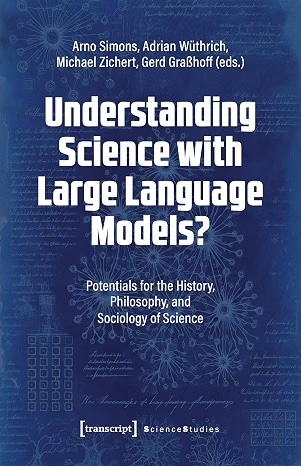
How are Large Language Models (LLMs) changing research in the history, philosophy, and sociology of science (HPSS)? Computer science develops powerful tools like LLMs, and HPSS explores the depth of their uses, limits, and broader consequences.
-
This book takes a very practical, systems-oriented approach to explain the performance side of Large Language Models (LLMs) like how Tensor Processing Units (TPUs) (and GPUs) work under the hood, how these devices communicate, and how LLMs actually run on real hardware. It also covers parallelism strategies for both training and inference to efficiently scale models at massive sizes.
-
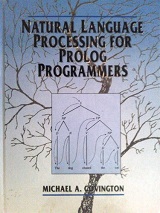
Research into Natural Language Processing - the use of computers to process language - has developed over the last couple of decades into one of the most vigorous and interesting areas of current work on language and communication.
-
Logic programming, an important new method of compute programming resulting from recent research in artifucial intelligence and computer science, has proved to be especially appropriate for solving problems in natrual-language processing.
-
Designed to bridge the gap for those who know Prolog but have little or no background in linguistics, this book concentrates on turning theories into practical techniques. Coverage includes template and keyword systems, definite clause grammars (DCGs), English syntax, unification-based grammar, parsing algorithms, semantics, and morphology. Helpful appendices present an in-depth review of Prolog and ready-to-use string input and tokenization routines
-
This book provides an overview of the recent advances in representation learning theory, algorithms, and applications for natural language processing (NLP), ranging from word embeddings to pre-trained language models.
-
This draft includes a large portion of our new Chapter 11, which covers BERT and fine-tuning, augments the logistic regression chapter to better cover softmax regression, and fixes many other bugs and typos throughout
-
This draft includes a large portion of our new Chapter 11, which covers BERT and fine-tuning, augments the logistic regression chapter to better cover softmax regression, and fixes many other bugs and typos throughout
-
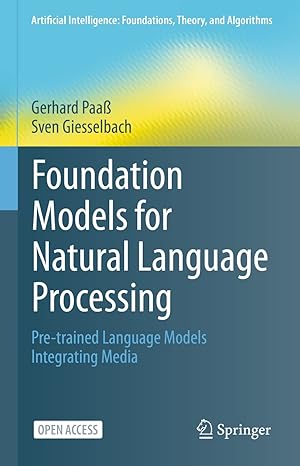
This open access book provides a comprehensive overview of the state of the art in research and applications of Foundation Models and is intended for readers familiar with basic Natural Language Processing (NLP) concepts.
-
This is a book about Large Language Models (LLM). As indicated by the title, it primarily focuses on foundational concepts rather than comprehensive coverage of all cutting-edge technologies. The book is structured into four main chapters, each exploring a key area: pre-training, generative models, prompting techniques, and alignment methods.