Neural Networks
Reference documents in Neural Networks.
Documents in Neural Networks
Page 1 of 2-
This book offers a comprehensive exploration of the foundational principles and advanced methodologies in neural networks and deep learning, begins with essential concepts in descriptive statistics and probability theory, laying a solid groundwork for understanding data and probability distributions.
-
Neural networks are an exciting field of software development used to calculate outputs from input data. While the idea seems simple enough, the implications of such networks are staggering - think optical character recognition, speech recognition, and regression analysis.
-
This overview incorporates every aspect of Recurrent Neural Networks (RNNs). It outlines the wide variety of complex learning techniques and associated research projects, investigates the following RNN models which solve some practical problems.
-
Covering major neural network approaches and architectures with the theories, this text presents detailed case studies for each of the approaches, accompanied with complete computer codes and the corresponding computed results.
-
From the basic building blocks of neural networks to advanced architectures, this book is designed to provide a thorough grounding in deep learning for readers at all levels of expertise.
-
Determining the right architecture is a computationally intensive process, requiring many trials with different candidate architectures. We show that the neural activation function, if allowed to individually change for each neuron, can implicitly control many aspects of the network architecture.
-
This book focus on developing new neural network architectures while taking such practical constraints into account, provides a clear and detailed coverage of fundamental neural network architectures and learning rules.
-
This is an elegant, compact book that renders visible the too-often naturalized equation of brain and computer. A critical examination of the figure of the neural network as it mediates neuroscientific and computational discourses and technical practices.
-
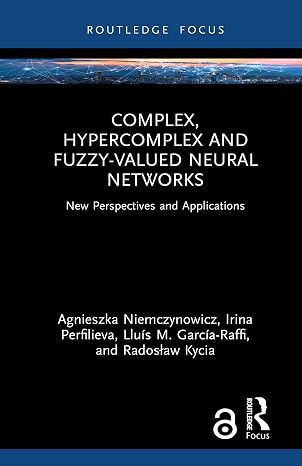
Complex, Hypercomplex, and Fuzzy-Valued Neural Networks are extensions of classical neural networks to higher dimensions. In recent decades, this theory has emerged as a forefront in neural networks theory.
-
This book gives you a complete walkthrough of the process of developing basic to advanced practical examples based on neural networks with Java.
-
This book investigates the following Recurrent Neural Networks (RNNs) models which solve some practical problems, together with their corresponding analysis on stability and convergence. A type of multilayer pole-assignment neural networks is applied to online synthesizing and tuning feedback control systems.
-
By presenting the latest research work the book demonstrates how real-time Recurrent Neural Networks (RNNs) can be implemented to expand the range of traditional signal processing techniques and to help combat the problem of prediction. Within this text neural networks are considered as massively interconnected nonlinear adaptive filters.
-
New applications in Recurrent Neural Networks (RNNs) are covered by this book, which will be required reading in the field. Methodological tools covered include ranking indices for fuzzy numbers, a neuro-fuzzy digital filter and mapping graphs of parallel programmes. The scope of the techniques profiled in real-world applications is evident from chapters on the recognition of severe weather patterns, adult and foetal ECGs in healthcare and the prediction of temperature time-series signals.
-
Beginning with an introductory discussion on the role of neural networks in scientific data analysis, this book provides a solid foundation of basic neural network concepts.
-
Though mathematical ideas underpin the study of neural networks, the author presents the fundamentals without the full mathematical apparatus. All aspects of the field are tackled, including artificial neurons as models of their real counterparts; the geometry of network action in pattern space; gradient descent methods, including back-propagation; associative memory and Hopfield nets; and self-organization and feature maps. The traditionally difficult topic of adaptive resonance theory is clarified within a hierarchical description of its operation.