Parallel Computing and Programming
Reference documents in Parallel Computing and Programming.
Documents in Parallel Computing and Programming
Page 1 of 2-
This textbook provides a step-by-step approach to numerical methods in engineering modelling. The authors provide a consistent treatment of the topic, from the ground up, to reinforce for students that numerical methods are a set of mathematical modelling tools which allow engineers to represent real-world systems and compute features of these systems with a predictable error rate.
-
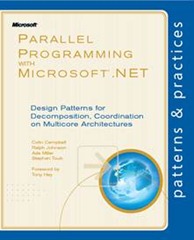
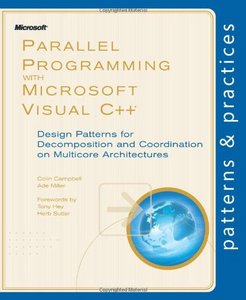
This book introduces design patterns for Decomposition and Coordination on Multicore Architectures. It describes parallelism within a single multicore node with shared memory instead of the cluster, High Performance Computing (HPC) Server approach that uses networked nodes with distributed memory.
-
This textbook examines languages and libraries for multithreaded programming. Readers learn how to create threads in Java and C++, and develop essential concurrent programming and problem-solving skills. Moreover, the textbook sets itself apart from other comparable works by helping readers to become proficient in key testing and debugging techniques. Among the topics covered, readers are introduced to the relevant aspects of Java, the POSIX Pthreads library, and the Windows Win32 Applications Programming Interface.
-
Your CPU meter shows a problem. One core is running at 100 percent, but all the other cores are idle. Your application is CPU-bound, but you are using only a fraction of the computing power of your multicore system. Is there a way to get better performance?
-
Focusing on algorithms for distributed-memory parallel architectures, Parallel Algorithms presents a rigorous yet accessible treatment of theoretical models of parallel computation, parallel algorithm design for homogeneous and heterogeneous platforms, complexity and performance analysis, and essential notions of scheduling. The book extracts fundamental ideas and algorithmic principles from the mass of parallel algorithm expertise and practical implementations developed over the last few decades.
-
Written by the team that developed the software, this tutorial is the definitive resource for scientists, engineers, and other computer users who want to use PVM to increase the flexibility and power of their high-performance computing resources.
-
This book approaches the grid computing with a perspective on the latest achievements in the field, providing an insight into the current research trends and advances, and presenting a large range of innovative research papers.
-
Grid research, rooted in distributed and high performance computing, started in mid-to-late 1990s. Soon afterwards, national and international research and development authorities realized the importance of the Grid and gave it a primary position on their research and development agenda. The Grid evolved from tackling data and compute-intensive problems, to addressing global-scale scientific projects, connecting businesses across the supply chain, and becoming a World Wide Grid integrated in our daily routine activities.
-
Nature abounds in systems involving the actions of simple, locally-interacting components, that give rise to coordinated global behavior. These collective systems have evolved by means of natural selection to exhibit striking problem-solving capacities, while functioning within a complex, dynamic environment. Employing simple yet versatile parallel cellular models, coupled with evolutionary computation techniques, this volume explores the issue of constructing man-made systems that exhibit characteristics such as those manifest by their natural counterparts.
-
The purpose of this book is to teach new programmers and scientists about the basics of High Performance Computing. Too many parallel and high performance computing books focus on the architecture, theory and computer science surrounding HPC. This book speaks to the practicing chemistry student, physicist, or biologist who need to write and run their programs as part of their research.
-
This book introduces the parallel paradigm, and shows how parallel programming is carried out using a variety of programming languages. Foster details actual applications examples from engineering, science, and finance while keeping the focus throughout on parallel programming as opposed to algorithm development.
-
A clear illustration of how parallel computers can be successfully applied to large-scale scientific computations. This book demonstrates how a variety of applications in physics, biology, mathematics and other sciences were implemented on real parallel computers to produce new scientific results.
-
This book provides an advanced guide to the issues of the parallel and multithreaded programming. It goes beyond the high-level design of the applications, into the details that are often overlooked but vital to make the programs work. The content is oriented towards the programming of the operating systems, servers and business applications.
-
Since its release in summer 1994, the Message Passing Interface (MPI) specification has become a standard for message-passing libraries for parallel computations. There exist more than a dozen implementations on a variety of computing platforms, from the IBM SP-2 supercomputer to PCs running Windows NT.
-
An overview of practical parallel computing and principles will enable the reader to design efficient parallel programs for solving various computational problems on state-of-the-art personal computers and computing clusters.