Quantum Computing
Reference documents in Quantum Computing.
Documents in Quantum Computing
Page 1 of 2-
Written by noted Quantum Computing theorist Scott Aaronson, this book takes readers on a tour through some of the deepest ideas of maths, computer science and physics. Full of insights, arguments and philosophical perspectives, the book covers an amazing array of topics.
-
The aim of this book is to develop “from the ground up” many of the major, exciting, re- and post-millennium developments in the general area of study known as quantum Shannon theory.
-
Quantum Theory is one of the pillars of modern science developed over the last hundred years. In this collection we introduce, step by step, the quantum theory understood as a mathematical model describing quantum experiments. We start with splitting the experiment into two parts: a preparation process and a measurement process leading to a registration of a particular outcome.
-
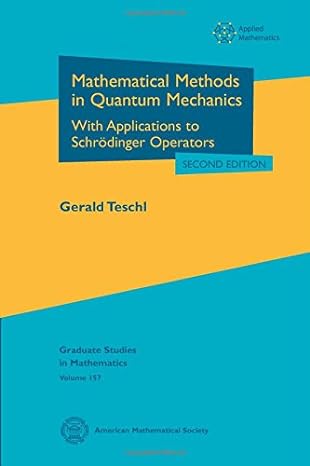
This book is a brief, but self-contained, introduction to the mathematical methods of quantum mechanics, with a view towards applications to Schrodinger operators. The author presents this material in a very clear and detailed way and supplements it by numerous exercises.
-
This essay gives a self-contained introduction to Quantum Game Theory, and is primarily oriented to economists with little or no acquaintance with quantum mechanics. It assumes little more than a basic knowledge of vector algebra. Quantum mechanical notation and results are introduced as needed. It is also shown that some fundamental problems of quantum mechanics can be formulated as games
-
The book at hand is meant to help you precisely with that: Understanding the basics of Quantum Mechanics, so that you can start asking the big questions and, with the help of modern physicists, find the answers to these questions as well.
-
Written by noted Quantum Computing theorist Scott Aaronson, this book takes readers on a tour through some of the deepest ideas of maths, computer science and physics. Full of insights, arguments and philosophical perspectives, the book covers an amazing array of topics.
-
Quantum mechanics, the subfield of physics that describes the behavior of very small (quantum) particles, provides the basis for a new paradigm of computing.
-
Quantum Computing provides a comprehensive introduction to the key applications of quantum mechanics, including quantum cryptography, quantum information, and quantum computing. This FreeBook features chapters culled from many of our best-selling quantum physics and quantum mechanics titles.
-
This is a free digital textbook that will teach you the concepts of Quantum Computing while you learn to use the Qiskit SDK.
-
Quantum Physics has some spectacular applications in computer science. This book is a concise introduction to Quantum Computation, developing the basic elements of this new branch of computational theory without assuming any background in physics.
-
This is a set of lecture notes suitable for a Master's course on Quantum Computing and information from the perspective of theoretical computer science. It introduces classical logic and quantum mechanics before presenting their integration in quantum computation.
-
This book is for students who want to learn Quantum Computing beyond a conceptual level, but who lack advanced training in mathematics. The only prerequisite is trigonometry, and mathematics beyond that will be covered, including linear algebra. This book is suitable as a course textbook or for independent study
-
This open access book makes Quantum Computing more accessible than ever before. A fast-growing field at the intersection of physics and computer science, quantum computing promises to have revolutionary capabilities far surpassing “classical” computation. Getting a grip on the science behind the hype can be tough: at its heart lies quantum mechanics, whose enigmatic concepts can be imposing for the novice.
-
This open access book explains the state of the art in quantum software engineering and design, independent from a specific hardware. It deals with quantum software theoretical aspects and with classical software engineering concepts like agile development approaches, validation, measurement, and deployment applied in a quantum or hybrid environment, and is complemented by a number of various industry applications.