Robotics and Robot Programming
Reference documents in Robotics and Robot Programming.
Documents in Robotics and Robot Programming
Page 1 of 2-
Robots and artificial intelligence (AI) are powerful forces that will likely have large impacts on the size, direction, and composition of international trade flows. This book discusses how industrial robots, automation, and AI affect international growth, trade, productivity, employment, wages, and welfare.
-
This open access book explores the intersection of robotics and physics and emphasizes the need for strict adherence to ethical principles in relation to overall progress and the development of humankind.
-
In this book, a set of relevant, updated and selected papers in the field of automation and robotics are presented. These papers describe projects where topics of artificial intelligence, modeling and simulation process, target tracking algorithms, kinematic constraints of the closed loops, non-linear control, are used in advanced and recent research.
-
Soon, robots will leave the factories and make their way into living rooms, supermarkets, and care facilities. They will cooperate with humans in everyday life, taking on more than just practical tasks. How should they communicate with us? Do they need eyes, a screen, or arms? Should they resemble humans? Or may they enrich social situations precisely because they act so differently from humans?
-
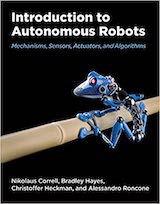
Autonomous robots may become our closest companions in the near future. While the technology for physically building such machines is already available today, a problem lies in the generation of the behavior for such complex machines.
-
This open access book explores what emotions we have when encountering robots, how we react emotionally to them in different contexts, and why these emotional responses are so important.
-
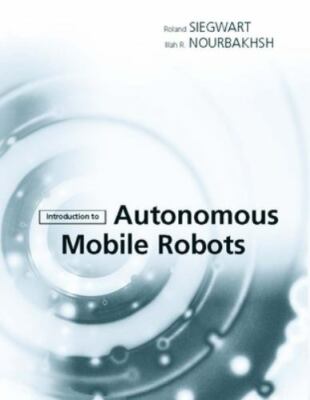
This book discusses all facets of mobile robotics, including hardware design, wheel design, kinematics analysis, sensors and perception, localization, mapping, and robot control architectures.
-
Robotics brings together several very different engineering areas and skills. There is metalworking for the body. There is mechanics for mounting the wheels on the axles, connecting them to the motors and keeping the body in balance. You need electronics to power the motors and connect the sensors to the controllers. At last you need the software to understand the sensors and drive the robot around.
-
This is a learner's handbook that provides a thorough foundation around robotics, including all the basic concepts. The book takes you through a lot of essential topics about robotics, including robotic sensing, actuation, programming, motion control, and kinematic analysis of robotic manipulators.
-
This book is a ROS robot programming guide based on the experiences we had accumulated from ROS projects like TurtleBot3, OpenCR and OpenManipulator. We tried to make this a comprehensive guide that covers all aspects necessary for a beginner in Robot Operating System (ROS).
-
The current state of the art in cognitive robotics, covering the challenges of building AI-powered intelligent robots inspired by natural cognitive systems. offering the first comprehensive coverage of building robots inspired by natural cognitive systems.
-
A textbooks that provide a broad algorithmic perspective on the mechanics and dynamics of robots, offers a much-needed resource for the computational fundamentals behind the design and control of autonomous robots. It covers principles of robot motion, forward and inverse kinematics of robotic arms and simple wheeled platforms, perception, error propagation, localization and simultaneous localization and mapping.
-
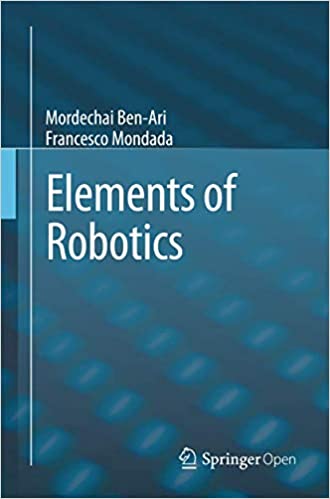
This book bridges the gap between playing with robots in school and studying robotics at the upper undergraduate and graduate levels to prepare for careers in industry and research. Robotic algorithms are presented formally, but using only mathematics known by high-school and first-year college students, such as calculus, matrices and probability. Concepts and algorithms are explained through detailed diagrams and calculations.
-
Developing robots to interact with humans is a complex interdisciplinary effort. This fills an important resource gap in the human–robot interactions (HRI) community, and acts as a guide to navigating design-specific methods, tools, and techniques.
-
This introduction to robotics offers a distinct and unified perspective of the mechanics, planning and control of robots. Ideal for self-learning, or for courses, as it assumes only freshman-level physics, ordinary differential equations, linear algebra and a little bit of computing background. Modern Robotics presents the state-of-the-art, screw-theoretic techniques capturing the most salient physical features of a robot in an intuitive geometrical way.