Algebra, Abstract Algebra, and Linear Algebra
Reference documents in Algebra, Abstract Algebra, and Linear Algebra.
Documents in Algebra, Abstract Algebra, and Linear Algebra
Page 1 of 2-
This book may be viewed as a tutorial and a set of notes on convex sets, polytopes, polyhedra, combinatorial topology, Voronoi Diagrams and Delaunay Triangulations. It is intended for a broad audience of mathematically inclined readers.
-
The prospect facing students still in need of Basic Algebra as they enter two-year colleges is a discouraging one inasmuch as it usually takes at the very least two semesters before they can arrive at the course(s) that they are interested in/or required to take, not to dwell on the fact that their chances of overall success tend to be extremely low.
-
This unique text presents the new domain of consistent non-linear counterparts for all basic objects and tools of linear algebra, and develops an adequate calculus for solving non-linear algebraic and differential equations. It reveals the non-linear algebraic activity as an essentially wider and diverse field with its own original methods, of which the linear one is a special restricted case.
-
Super Linear Algebras are built using super matrices. These new structures can be applied to all fields in which linear algebras are used. Super characteristic values exist only when the related super matrices are super square diagonal super matrices. Super diagonalization, analogous to diagonalization is obtained. These newly introduced structures can be applied to Computer Sciences, Markov Chains, and Fuzzy Models.
-
This book avoids the traditional definition-theorem-proof format; instead a fresh approach introduces a variety of problems and examples all in a clear and informal style. The in-depth focus on applications separates this book from others, and helps students to see how linear algebra can be applied to real-life situations. Some of the more contemporary topics of applied linear algebra are included here which are not normally found in undergraduate textbooks.
-
This textbook was written with two goals in mind: to present the skills of algebra in the context of modeling and problem solving, and to engage students in an activity-based course.
-
This textbook, Elementary Algebra, is the first part, written in a clear and concise manner, making no assumption of prior algebra experience. It carefully guides students from the basics to the more advanced techniques required to be successful in the next course.
-
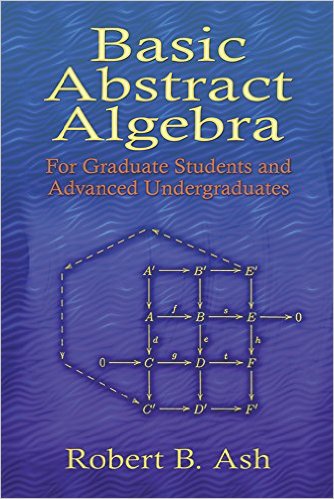
Geared toward upper-level undergraduates and graduate students, this text surveys fundamental algebraic structures and maps between these structures. Its techniques are used in many areas of mathematics, with applications to physics, engineering, and computer science as well. Author Robert B. Ash, a Professor of Mathematics at the University of Illinois, focuses on intuitive thinking. He also conveys the intrinsic beauty of abstract algebra while keeping the proofs as brief and clear as possible.
-
Basic Algebra includes chapters on Preliminaries about the Integers, Polynomials, and Matrices; Vector Spaces over Q, R, and C; Inner-Product Spaces; Groups and Group Actions; Theory of a Single Linear Transformation; Multilinear Algebra; Advanced Group Theory; Commutative Rings and Their Modules; Fields and Galois Theory; Modules over Noncommutative Rings.
-
Advanced Algebra includes chapters on modern algebra which treat various topics in commutative and noncommutative algebra and provide introductions to the theory of associative algebras, homological algebras, algebraic number theory, and algebraic geometry. Many examples and hundreds of problems are included, along with hints or complete solutions for most of the problems.
-
French mathematician Evariste Galois developed the Galois theory of groups-one of the most penetrating concepts in modem mathematics. The elements of the theory are clearly presented in this second, revised edition of a volume of lectures delivered by noted mathematician Emil Artin.
-
This textbook introduces the basic notions of group theory by a thorough treatment of important examples, including complex numbers, modular arithmetic, symmetries, and permutations. Also included are applications to communications, cryptography, and coding theory.
-
This book includes content found in a typical algebra course, along with introductions to curve-fitting and display of data. The authors focus on three core themes throughout their textbook: Modeling, Functions, and Graphs. In their work of modeling and functions, the authors utilize the Rule of Four, which is that all problems should be considered using algebraic, numerical, graphical, and verbal methods.
-
These books use a teacherly writing style and a careful blend of skills development and conceptual questions to meet the unique needs of the developmental math student. It takes advantage of experiences in the classroom and an editing eye to offer one of the most well-rounded series available, written with the developmental learner in mind.