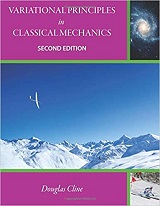
Variational Principles in Classical Mechanics
Overview & Synopsis
Two dramatically different philosophical approaches to classical mechanics were proposed during the 17th – 18th centuries. Newton developed his vectorial formulation that uses time-dependent differential equations of motion to relate vector observables like force and rate of change of momentum. Euler, Lagrange, Hamilton, and Jacobi, developed powerful alternative variational formulations based on the assumption that nature follows the principle of least action. These variational formulations now play a pivotal role in science and engineering.
Indexed from repository: FreeComputerBooks.com
(
freecomputerbooks.com)
Keyboard Shortcuts:
← / → for pages • + / - for zoom • 0 to fit width
Powered by Mozilla PDF.js v3.11
Document Information
| Document Title | Variational Principles in Classical Mechanics |
|---|---|
| Author / Organization | Douglas Cline |
| Subject & Discipline | Physics, Computational Physics, and Mathematical Physics, Applied Mathematics, Calculus and Mathematical Analysis (Real Analysis, Functional Analysis, etc.) |
| Categories | Physics, Computational Physics, and Mathematical Physics |
| Publication Year | 2018 |
| ISBN | 099883727X |
| License / Rights | CC BY-NC-SA 4.0 |
| Resource Verification | PDF Unavailable at Remote Host |
| Original Host Website |
FreeComputerBooks.com
(freecomputerbooks.com)
|
| File Format | application/pdf (Portable Document Format) |
| Language | ENGLISH |
| Catalog ID | DOC-113536 |
| Original Source Link | Visit Source Page on freecomputerbooks.com » |
Commercial / Print Edition
Prefer a Physical Book or Kindle Edition?
Variational Principles in Classical Mechanics • Print Edition
As an Amazon Associate, MainReads earns from qualifying purchases.